
I finally booked my ticket to Seattle. It looked spontaneous from the outside, but it was decades in the making. Loving Nirvana when I was young did more than shape my music taste. It shaped my imagination. Through those records, Seattle stopped being a city on a map and became a place I carried with me.
Long before I ever arrived, I knew its streets. I knew why Capitol Hill mattered. I knew the addresses tied to Layne Staley and the corners where Kurt Cobain was last seen. I knew the venues where Pearl Jam and Soundgarden forged their sound, the weight of Pike Place Market in the city’s daily rhythm, and even the darker chapters that still linger in the background. I have been reading The Seattle Times for years! Sometimes I felt as if I already lived there.
When I decided to go, I realised something quietly powerful. I did not need months of anticipation. I had already been preparing for this trip my entire life. All I needed was a date!
What followed was not tourism. It was a personal pilgrimage. My itinerary included a real personal journey to places connected to the history of grunge music and the people who have shaped my entire life. Some go to Jerusalem, others to Santiago de Compostela, and others, to Seattle.
This guide is the result of that journey. Every location listed here was personally visited. Every photograph was taken by me. These are not borrowed stories. They are lived ones.
After that first visit in 2024, I thought I had closed a circle. But Seattle does not let you leave so easily. I returned the following year with more knowledge, more stories, and a deeper understanding of what the city holds beyond the mythology. The second time felt less like a dream and more like a conversation. And now, as I prepare for my third visit (yes, you read it right), I realise this is no longer a pilgrimage I needed to complete. It is a relationship I continue to build.
After two separate ten-day trips, each dedicated almost entirely to walking this circuit, something also shifted. What started as devotion became research. What began as nostalgia turned into documentation.
When you bring together a journalist, a travel specialist and a lifelong grunge lover in a city like Seattle, you cannot keep that experience to yourself. You start noticing patterns. You connect addresses. You verify stories. You stumble upon details that are not circulating in forums or fan communities. Some discoveries happened almost by accident (spoiler: like finding Layne Staley’s lesser-known residence, an address not openly listed or widely shared!).
I realised that what I had gathered was more than personal memory. It was material. Structure. A route.
That is how this became a 70-page guide mapping 44 locations directly connected to the grunge movement, accompanied by carefully selected 35 extra recommendations, including cafés, restaurants and local spots that genuinely enhance the experience. It is a guide for those who want to take this journey seriously and ground it in reality. For the devoted fans who want to walk with context. For the curious who want to understand what really happened here. I went first, so you can go better.
The complete version, with the full route, every address and the entire photographic archive, including the cultural + political context of 90s Seattle, to understand the backdrop that shaped the sound and the scene, is available for those who want to carry the whole circuit with them, without edits or omissions. What you will find below is a more condensed version of that journey.
I share it because I feel a quiet responsibility toward the artists who shaped my life. Toward the city that held them. Toward the music that raised so many of us. Passing this knowledge forward feels less like publishing and more like honouring.
Thus, if you want to trace the same path, I am giving you direct, fast-track access to the places that matter. Not only the well-known landmarks, but also the addresses and neighbourhoods that still carry the atmosphere of the early 1990s.
Seattle changed music forever. Walking its streets, you feel why.
Queen Anne
Perched above the city with sweeping views of Elliott Bay and the Seattle skyline, Queen Anne blends residential calm with cultural landmarks tied to the city’s artistic history. In the 1990s, it was not considered a grunge epicentre in the same way as Capitol Hill or Belltown, but it quietly housed key figures of the movement, including Layne Staley, during a pivotal period. Today, its tree-lined streets and elevated vantage points create a striking contrast between serenity and the raw musical energy that once moved through its homes and rehearsal conversations. Queen Anne reminds you that not all chapters of the Seattle Sound were written on stage. Some were written in living rooms.
Layne Staley’s Queen Anne Residence
Not everyone is familiar with Layne Staley’s former address in Lower Queen Anne. He lived here between 1994 and 1996, during a period that would become central to Seattle’s musical mythology. The house, located at 552 Ward Street, is a typical residential property and far more visible than his later condo in the University District.
It was during this era that conversations began, which would eventually lead to the formation of Mad Season. Standing outside, you realise how ordinary the setting is. No dramatic architecture. No spectacle. Just a quiet Seattle street that once held moments that shaped an entire chapter of the city’s sound.
What few people know is that Layne had yet another address in Seattle from a similar period, far less discussed and rarely documented. That one is not openly listed here, but it is carefully mapped inside the complete guide for those who want the full picture.
This stop sets the tone for the entire circuit. Many of the places that defined grunge are not monumental. They are embedded in everyday neighbourhoods.
Kerry Park
Across from Kerry Park, the skyline unfolds in a way that feels almost cinematic. The old buildings still standing here formed the backdrop for one of Andrew Wood’s most iconic photographs.
You can stand in the same spot, looking over the city that carried Mother Love Bone, Soundgarden and so many others. The panoramic view from 211 W Highland Dr remains one of the most striking in Seattle. It is a reminder that the city itself was always part of the aesthetic. Grey skies, layered architecture, water and mountains framing everything.
Museum of Pop Culture (MoPOP)
MoPOP remains one of the most important institutional archives of Seattle’s music history. Located at 325 5th Ave N, it houses exhibitions that document the evolution of rock, science fiction and popular culture, with the Pacific Northwest at its core.
For fourteen years, Nirvana: Taking Punk to the Masses functioned almost as a permanent shrine within the museum. I happened to be there on its final day. Being the last visitor to leave that exhibition felt deeply symbolic. Closing that door was not simply the end of a display. It marked the end of an era of public storytelling around Nirvana’s early years.
According to reporting from The Seattle Times, the closure was influenced by logistical realities. Many of the items had been on loan from private collectors and band members. Space and funding also played a role. As MoPOP’s leadership has emphasised, the museum must continuously evolve to reflect broader and more inclusive narratives of Pacific Northwest music.
That said, Nirvana’s presence remains embedded in the institution’s identity. As one of MoPOP’s curators stated, Nirvana is part of the museum’s DNA. It is not disappearing from Seattle’s story.
KEXP
Within Seattle Center, KEXP continues to embody the city’s independent music ethos. This non-commercial radio station has supported alternative and emerging artists for decades, extending the legacy of discovery that defined the grunge era.
While not strictly a 1990s landmark in the same way as The Central or The Crocodile, KEXP represents continuity. The spirit of experimentation and independence did not end with the first wave of grunge. It evolved. 472 1st Ave N.
Pioneer Square
Pioneer Square is Seattle’s oldest neighbourhood, defined by brick facades, iron pergolas and underground passageways that reflect the city’s late nineteenth-century origins. By the late 1980s and early 1990s, it became one of the earliest gathering grounds for what would evolve into the grunge movement. Small venues, rehearsal spaces and label offices operated within its historic buildings, creating an unlikely bridge between Victorian architecture and distorted guitars. Walking through Pioneer Square today, you feel layers of time stacked on top of each other. It is both a historic district and a musical origin point.
OK Hotel
Located in Pioneer Square, the OK Hotel holds a foundational place in grunge history. It was here that Nirvana first performed Smells Like Teen Spirit in 1991, long before it became an anthem that would redefine alternative music worldwide.
The venue no longer exists in its original form, but standing in front of 212 Alaskan Way S, it is impossible not to imagine the early 1990s energy that once filled that room. This was also one of the filming locations for Singles, anchoring Pioneer Square not only in music history but in cultural memory.
Just nearby stood Pier 48, where Nirvana recorded the Live and Loud concert in December 1993. Though the structure is gone, knowing the geography reshapes how you walk this area. Pioneer Square is not just the oldest part of Seattle. It is layered with origin stories.
The Central Saloon
Often described as the birthplace of grunge, The Central Saloon remains one of the most emotionally charged stops on the circuit. Located at 207 1st Ave S, this is where Sub Pop first saw Nirvana live. Alice in Chains, Soundgarden, Mother Love Bone and The Melvins all played this stage while the movement was still forming.
Inside, the venue feels less like a bar and more like a shrine. Photographs of Layne Staley and Kurt Cobain line the walls. Flyers from early gigs still hang. The stage is small, intimate, almost vulnerable.
There is also a literal altar in the centre honouring Layne Staley, Andrew Wood, Jimi Hendrix and Chris Cornell. Candles. Photographs. Quiet reverence. It feels less commercial and more communal. A place where history is not archived behind glass but lived in the air.
Belltown
In the late 1980s and early 1990s, Belltown was gritty, affordable and creatively dense. Flophouses, rehearsal rooms and small clubs coexisted within a few walkable blocks, allowing musicians to live, practice and perform within the same ecosystem. It was here that many of the foundational venues of the Seattle Sound operated, shaping the city’s underground identity before global recognition arrived. Though gentrification has reshaped parts of the neighbourhood, Belltown still carries traces of its former roughness. Beneath newer developments, the bones of the movement remain.
Black Dog Forge
Behind 2316 2nd Avenue, in a small alley space, Black Dog Forge operated as a rehearsal room in the late 1980s and early 1990s. Pearl Jam helped soundproof the room by attaching blankets to exposed pipes. Soundgarden, Temple of the Dog and other early Seattle bands used the space during their formative years.
There is nothing visually dramatic about the alley today. That is precisely the point. Many of the most important moments in Seattle’s music history happened in places that never announced themselves.
Studio X (formerly Bad Animals Studio)
At 2212 4th Avenue, what was once Bad Animals Studio played a role in recording key works from the emerging Seattle scene. Bands including Nirvana, Soundgarden, Alice in Chains and Pearl Jam recorded here as the movement gained international attention.
Now renamed Studio X, the building remains active. Its legacy is not frozen in nostalgia. It continues as a working studio, linking past and present.
The Crocodile
The Crocodile opened in April 1991 and quickly became one of Seattle’s most significant live venues. Legendary performances took place here, including the infamous Mudhoney show in 1992, when Nirvana appeared under the pseudonym Pen Cap Chew.
The original venue stood at 2200 2nd Avenue. The current location at 2505 1st Ave continues that lineage. While the building may have evolved, the role it plays in the city’s live music ecosystem remains central.
In January 2026, it was announced that The Crocodile was up for sale after 35 years of independent ownership. The decision followed the closure of its smaller rooms, Madame Lou’s and Here After, which were operating at a loss. The venue entered receivership after accumulating more than $1.6 million in debt.
The ownership group includes a collective of limited partners, including Alice in Chains drummer Sean Kinney, band manager Susan Silver, Eric Howk of Portugal, and Seattle entrepreneur Marcus Charles.
Despite the financial restructuring, the club remains open and continues operating as one of Seattle’s central live music institutions.
The Vogue
At 2018 1st Avenue once stood The Vogue, a venue where Mudhoney, Alice in Chains and Nirvana performed in their earliest years. Nirvana’s first well-attended Seattle show took place here in 1988.
Today, a vintage clothing store occupies the space. Stepping inside offers a surprisingly tangible sense of what the venue once was. The original walls remain, worn and textured, and even the fitting rooms give subtle clues about the structure’s past layout. It does not feel entirely erased. It feels layered.
Simply standing on that floor carries a particular awareness. Layne Staley stood here. Kurt Cobain stood here. The physical continuity of the space makes the history feel less abstract and more immediate.
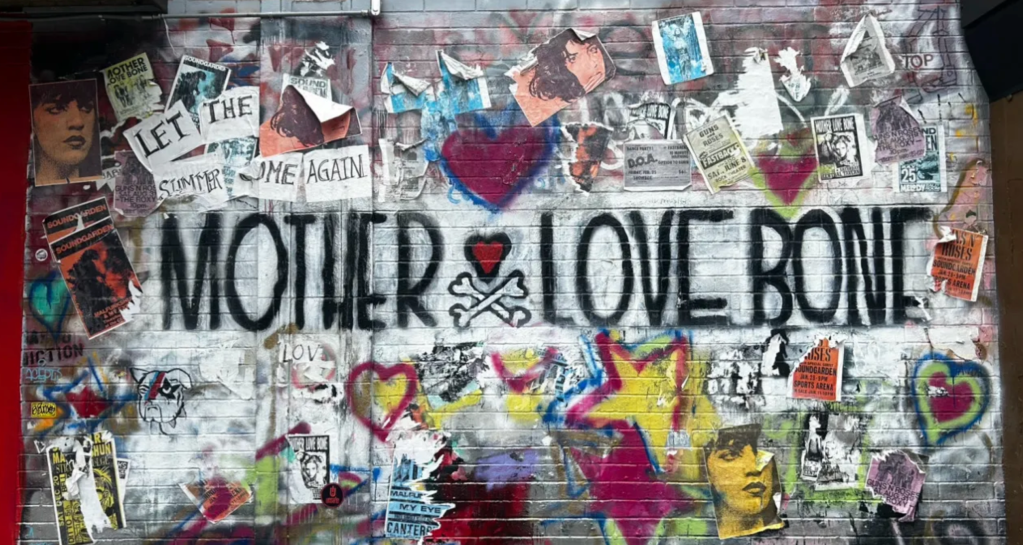
On the side of the building once stood one of the most recognisable Mother Love Bone murals from the peak of the grunge era, a visual marker of Belltown’s creative pulse. Although the neighbourhood has evolved significantly, Belltown still carries an undercurrent of that underground spirit if you know where to look.
Screwdriver Bar
Before becoming Screwdriver Bar in 2016, the basement space at 2320 1st Avenue served as Nirvana’s rehearsal room during the transition from Bleach to Nevermind. It also hosted other bands navigating the late 1980s underground scene.
The room sat unused for decades before being revived. Today, it operates as a bar, but the physical structure remains. Being inside is a reminder that global shifts in music often begin in modest, dimly lit rooms.
Sub Pop Headquarters (Original Location)
The former Sub Pop headquarters at 1932 1st Avenue in the Terminal Sales Building represents the business nerve centre of the Seattle Sound. From this office, the label that launched Nirvana and Soundgarden helped define a global movement.
Standing across from Pike Place Market, it anchors grunge not only in basements and clubs, but in infrastructure.
Capitol Hill
Capitol Hill was the social and creative nucleus of 1990s Seattle. With relatively low rents at the time, it attracted musicians, artists and outsiders who found community within its dense, walkable streets. The neighbourhood’s nightlife scene, long shaped by LGBTQ+ bars, expanded in the early 1990s to include rock-driven venues that became gathering points for the emerging grunge scene.
Capitol Hill may not host as many headline addresses as Belltown, but it holds something more intimate: it was where the protagonists who defined the early 1990s scene lived, argued, created, and existed. They shared houses, hosted gatherings and moved between venues on foot. To understand the Seattle Sound, you have to experience this district and walk the streets where these lives unfolded in ordinary, unfiltered ways.
The area’s architecture remains one of its most charming aspects. Brick apartment buildings, modest houses and low-rise structures still carry the aesthetic of that era. Many of these spaces were not just homes but informal rehearsal rooms and late-night meeting points where ideas were exchanged, and bands were formed. Groups such as The Gits began in shared houses within this environment (famously known as The Rathouse), reinforcing how deeply the district shaped the scene. It is no coincidence that Capitol Hill was chosen to represent the residential world of the characters in Singles.
Coryell Court Apartments
Located at 1820 E Thomas St, Coryell Court became iconic through its portrayal in Singles. Beyond cinema, Capitol Hill itself functioned as the social and creative core of the grunge scene. Musicians lived, rehearsed and gathered in these blocks.
The building is still residential. Visiting requires discretion. The importance lies less in spectacle and more in understanding how tightly woven daily life and music were in this neighbourhood.
The Comet Tavern
At 922 E Pike St, The Comet remains one of the few venues that still visually resembles its 1990s incarnation. Soundgarden and Mudhoney played here. It also carries a solemn association with Mia Zapata of The Gits, whose death deeply impacted the Seattle music community.
The Comet feels preserved not through restoration but through continuity. Its walls still hold the texture of that era.
Linda’s Tavern
Located at 707 E Pine St, Linda’s Tavern holds a complex and enduring place in Seattle’s music history.
Opened in 1994 by Linda Derschang and Dave Meinert, the bar quickly became a gathering point for musicians, touring artists and locals. Among its ownership circle is also Bruce Pavitt, cofounder of Sub Pop Records, the label that helped launch Nirvana and shape the global trajectory of the Seattle Sound. That connection alone places Linda’s within the structural backbone of the grunge movement, not just its folklore.
When it opened, Capitol Hill was very different from what it is today. Much of the nightlife scene at the time centred around gay bars, which had long defined the district’s identity. The Comet and Linda’s opened their doors with a more rock-driven atmosphere, offering a different kind of social space for musicians and artists living nearby. Rents were still relatively affordable in the early 1990s, one of the reasons so many bands and creatives settled in the neighbourhood. Capitol Hill was not yet polished. It was dense, accessible and culturally charged.
Linda’s quickly became one of the district’s central meeting points. It was a stop for musicians passing through Seattle and a regular haunt for locals. Its most widely known historical association remains that Kurt Cobain was last seen publicly here in early April 1994 before his death days later, a detail that permanently etched the tavern into the city’s collective memory.
Today, Linda’s has preserved much of its original structure and atmosphere. It remains a relaxed stop in Capitol Hill for a beer and simple finger foods, but it also carries a quiet gravity. Sitting there, you feel how inseparable daily life and music once were in this district.
Caffe Vita
Originally known as Café Paradiso, this location became a gathering point for artists and musicians during the 1990s. Layne Staley was known to spend time here. The space retains its old school interior and atmosphere, making it one of the few coffee houses still directly tied to that era.
University District
Anchored by the University of Washington, the University District has long been a mix of students, artists and transient creative energy. In the 1990s, its bars, rehearsal spaces and modest residential buildings offered both anonymity and accessibility to musicians navigating sudden visibility. The U District is less mythologised than Capitol Hill or Belltown, yet it holds deeply personal chapters of the Seattle Sound, particularly in its quieter, more introspective moments. It represents a different side of the movement. Not the explosion, but the aftermath.
Layne Staley’s Final Residence
At 4528 8th Ave NE, unit 5C, Layne Staley lived during his final years from 1997 until his death in 2002. The building remains residential and should be approached respectfully.
This stop is one of the most emotionally complex on the circuit. It marks the quiet ending of a voice that defined a generation.
Blue Moon Tavern
Opened in 1934 at 712 NE 45th St, the Blue Moon Tavern is one of Seattle’s oldest surviving bars and long predates the grunge era. Its reputation as a gathering place for writers, musicians and outsiders made it a natural extension of the University District’s creative undercurrent.
During his later years, Layne Staley was known to frequent the Blue Moon, given its proximity to his condo in the U District. The tavern’s worn interior, low lighting and unpolished atmosphere make it one of the few places in the neighbourhood that still feels structurally connected to the 1990s.
Members of Nirvana, in the peak of their fame post-Nevermind, would occasionally retreat there to avoid attention after appearances nearby, including record store events in the area. While not extensively documented, the story reflects the venue’s role as a discreet refuge within the University District’s tight-knit music ecosystem.
Today, the Blue Moon remains operational, hosting live music and maintaining a deliberately unrefined character that mirrors the spirit of the era it helped shelter.
Neptune Theatre
Located just minutes from Layne Staley’s former residence, the Neptune Theatre stands as one of the University District’s most significant performance spaces. Originally opened in 1921 as a movie palace, it later evolved into a concert venue that hosted artists connected to Seattle’s alternative scene.
Although not exclusively a grunge venue, the Neptune played an important role in sustaining the city’s live performance culture. Mark Lanegan reopened the restored Neptune Theatre in 2011 with an acoustic show, reinforcing its link to the Seattle Sound. Over the years, it has hosted benefit concerts, Layne Staley’s annual tribute show, reunions and performances tied to bands that defined the 1990s movement.
Downtown
Downtown Seattle provided the larger stages that carried the movement beyond the underground. Theatres and established venues hosted performances that signalled the transition from local scene to international phenomenon. Positioned between Pike Place Market and the financial core of the city, Downtown embodies the tension between commerce and counterculture that defined the early 1990s. Here, grunge moved from basement shows into historic auditoriums, without entirely shedding its edge.
The Showbox
At 1426 1st Avenue, The Showbox stands directly across from Pike Place Market. Soundgarden, Pearl Jam, Mudhoney and other defining bands performed here. It remains operational, one of the few surviving large venues from the early 1990s era.
The Moore Theatre
Located at 1936 2nd Avenue, The Moore hosted significant performances from Soundgarden, Alice in Chains and Mad Season. The venue’s architecture contrasts with the underground aesthetic often associated with grunge, yet it played a crucial role in amplifying the movement and registering historic shows.
Paramount Theatre
At 911 Pine St, Nirvana performed in 1991 during the Nevermind era. The theatre remains active, connecting Seattle’s historic performance spaces with contemporary touring circuits.
Re Bar
Formerly located at 1114 Howell St, Re Bar hosted Nirvana’s Nevermind release party and functioned as a cultural hub for artists across subcultures. Though the original space has changed function, its role in the mythology of early 1990s Seattle remains significant.
RKCNDY
Known as “Rock Candy,” RKCNDY operated at 1812 Yale Ave during the early and mid-1990s and quickly became one of Seattle’s essential all-ages venues. At a time when many clubs were 21 and over, RKCNDY offered space for younger audiences and emerging bands to collide in the same room.
It hosted a wide spectrum of alternative and underground acts, including performances tied to the expanding Seattle Sound. The venue became known for its raw, no-frills atmosphere, a place where volume, sweat, and proximity defined the experience.
The building no longer functions as a music venue. It is now a hotel. That transformation says something about the city’s evolution. But for several formative years, this was a room where the underground gathered before the world paid attention.
Off Ramp
Located at 109 Eastlake Ave E, Off Ramp was one of the most important early stages for what would become global bands. It was here that Mookie Blaylock, soon to be renamed Pearl Jam, made their debut performance. Alice in Chains, Nirvana, Soundgarden and The Melvins all played this stage in the early 1990s.
Unlike many venues that disappeared entirely, the building survives under a new name, El Corazon. The structure remains, even if the branding has changed. That continuity allows you to stand in a space where the Seattle Sound was still forming, before the record deals, before the international tours.
West Seattle
Separated from the city centre by water, West Seattle has always carried a slightly independent rhythm. More residential and less frenetic than central neighbourhoods, it became intertwined with the Seattle Sound through institutions like Easy Street Records and through the lives of musicians who sought space away from the urban core. The slower pace and strong community feel give West Seattle a grounded presence within the broader movement narrative.
Easy Street Records
Located at 4559 California Ave SW in West Seattle, Easy Street Records is one of the city’s most enduring institutions tied to the Seattle Sound.
More than just a record store, Easy Street has long been intertwined with Pearl Jam’s history. The band famously performed here, including the show that became Live at Easy Street. Over the years, the store has hosted in-store performances and signings, functioning as both an archive and an active cultural space.
Outside, murals honour Mother Love Bone and Chris Cornell, reinforcing the neighbourhood’s ongoing connection to the movement. Inside, vinyl, photographs and memorabilia create an atmosphere that feels less curated for tourists and more embedded in local memory.
Ballard
With Scandinavian roots and a working-class maritime history, Ballard was not initially synonymous with grunge. Yet its warehouses and industrial spaces provided crucial rehearsal environments during the late 1980s. Places like the Music Bank became incubators for bands that would later define the Seattle Sound. Ballard reflects the movement’s industrial backbone. Practical spaces. Loud rooms. No pretence.
The Music Bank
Once located at 1454 NW 45th Street beneath the Ballard Bridge, The Music Bank functioned as a rehearsal space and informal housing for numerous bands, including Alice in Chains and Pearl Jam.
The name later inspired Alice in Chains’ box set. Though the building has changed, its reputation as a crucible of creativity endures.
Madrona
Madrona, overlooking Lake Washington, is one of Seattle’s most tranquil residential neighbourhoods. Its calm streets and waterfront views stand in stark contrast to the turbulence often associated with grunge mythology. Yet it holds one of the most emotionally charged sites in the city’s music history. Madrona represents the private side of public icons, where domestic life and global fame intersected in fragile ways.
Kurt Cobain’s Final Residence
At 171 Lake Washington Boulevard East stands the house where Kurt Cobain spent his final months and where he was found in April 1994. The property remains privately owned and is not open to the public. It should be approached with discretion and distance.
Adjacent to the house lies Viretta Park, a small green space that has quietly become a site of collective remembrance. Two benches inside the park are covered in carvings, letters, lyrics and messages left by visitors from around the world. Some are recent. Some have weathered into the wood over decades.
Standing there is different from reading about it. The house overlooks Lake Washington, calm and expansive, framed by trees and soft light. The setting feels almost painfully serene. It complicates the narrative. The mythology dissolves into something human.
This stop is not about spectacle. It is about stillness. It is about understanding that the Seattle Sound was not only loud and revolutionary. It was also fragile.
First Hill
Often referred to as “Pill Hill” due to its concentration of hospitals and medical centres, First Hill is a quieter, transitional neighbourhood between Downtown and Capitol Hill. It lacks the overt performance venues of other districts, yet it carries intimate chapters of the Seattle Sound through residential ties to key figures of the era. First Hill reminds you that the movement was not confined to stages. It was embedded in everyday addresses.
Mark Lanegan’s Residence
Located at 423 Terry Avenue, Mark Lanegan lived here during a period when his friendship with Layne Staley was central to his life. The address is referenced in his memoir Sing Backwards and Weep, anchoring it within documented history.
North Seattle
Beyond the city’s central neighbourhoods, North Seattle and Shoreline housed recording studios that captured the sound itself. While not culturally dense in the same way as Capitol Hill or Belltown, these areas played a technical and creative role in shaping the records that carried Seattle to the world. The mythology may live in clubs, but the music was refined in studios like London Bridge, where the Seattle Sound was pressed into permanence.
London Bridge Studio
At 20021 Ballinger Way NE in Shoreline, London Bridge Studio recorded some of the most defining albums of the Seattle Sound, including Pearl Jam’s Ten and Alice in Chains’ Jar of Flies.
Touring the studio offers rare access to the physical spaces where those records were created, including the vocal booths used by Layne Staley, Chris Cornell and Eddie Vedder.
 grunge seattle
Leave a comment