
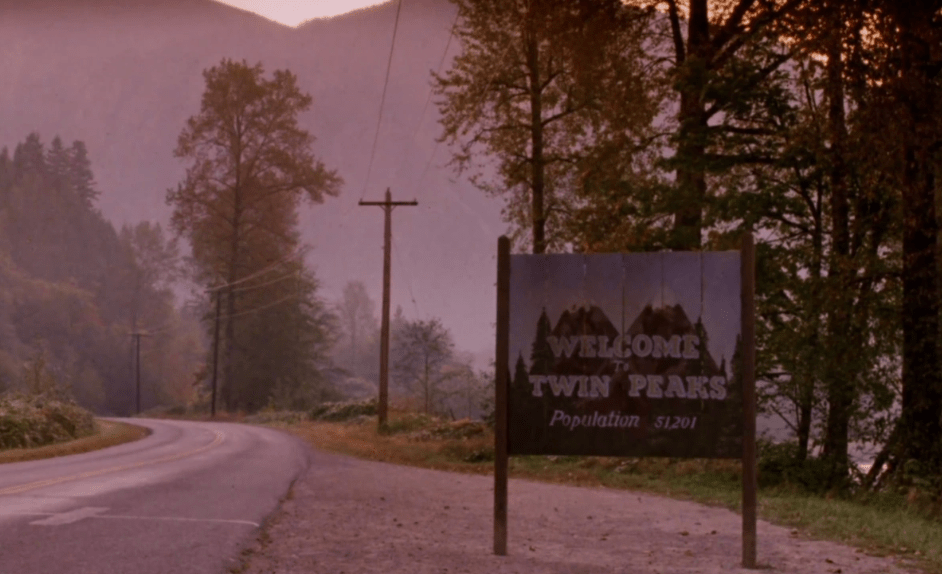
Three major works about domestic evil disguised as normalcy — Twin Peaks, Fire Walk With Me, and The Hand That Rocks the Cradle — were all produced in Washington State within a three-year window. The region was not making art. It was generating symptoms.
Pacific Northwest · 1990–2002 · A Reckoning
There is a log on a rocky beach at Kiana Lodge in Poulsbo, Washington, chained down so the tides don’t carry it away. It has been there since March 1989, when a film crew came to shoot the opening scene of a strange new television series: a dead girl, wrapped in plastic, discovered at the water’s edge. The log became one of the most iconic images in television history. Pilgrims still come to see it, from all over the world, and stand quietly beside it at the shore of Puget Sound.
What most of them do not know is that thirteen years after that scene was filmed, a private memorial service was held inside the same lodge for Layne Staley, the lead singer of Alice in Chains, who had just died in Seattle of a drug overdose. He had chosen Kiana Lodge himself. It was the place where he had intended to get married. That is not a metaphor. It is a fact. And it is the kind of fact that, once you know it, makes you see an entire era differently.
The Geography of Dread

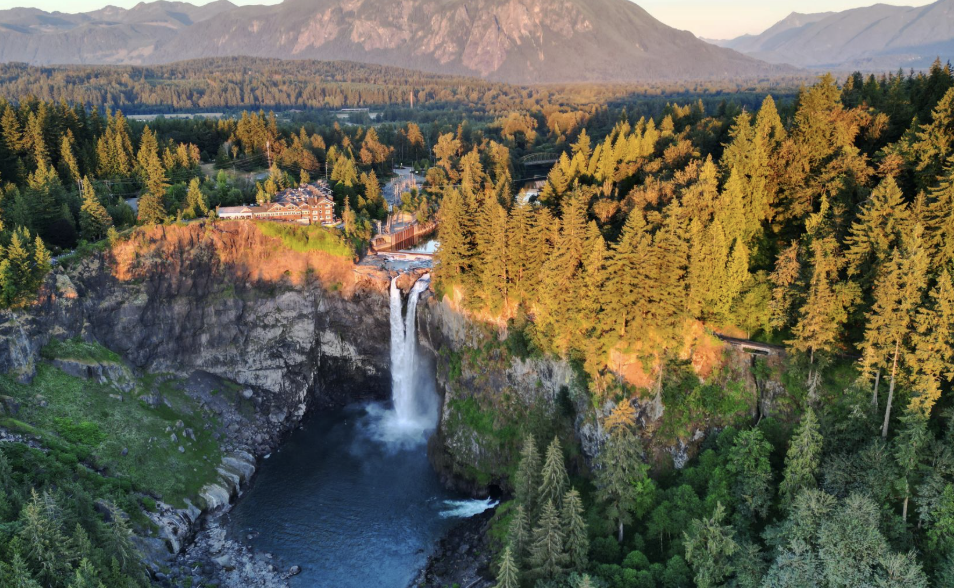
Twin Peaks was filmed primarily in Snoqualmie and North Bend, Washington — small towns nestled in the foothills of the Cascades, thirty miles east of Seattle. Lynch chose the location not merely for its visual drama (the Douglas firs dense as cathedral columns, the waterfalls, the diners with their red vinyl booths and fluorescent lights) but because those visuals concealed something. The show understood what few outsiders grasped about the region: that extraordinary natural beauty and profound human darkness are not opposites here. They are neighbors. Sometimes they are the same address.
The premise, a beautiful homecoming queen murdered, her death exposing the rot beneath a picture-perfect small town, reads almost like a regional folk tale. Washington State had, by 1990, already produced Ted Bundy, who had studied at the University of Washington and committed crimes throughout the Pacific Northwest. The Green River Killer, Gary Ridgway, was actively operating across King County throughout the 1980s and into the early 1990s, disposing of victims near rivers and roadsides within driving distance of the Twin Peaks filming locations. He was not caught until 2001. During the entire original run of the show, he was at large. During the entire flowering of the Seattle music scene, he was at large. The two great cultural phenomena of the Pacific Northwest’s early nineties existed, without knowing it, in the shadow of an actual serial killer who had claimed over 49 lives and was never once called to account during that time.
Lynch did not import his darkness from elsewhere. He simply opened his eyes.
The real Washington State locations behind the show:
- Kiana Lodge, Poulsbo — Great Northern Hotel interiors; the beach where Laura Palmer’s body is found. Owned by the Suquamish Tribe
- Snoqualmie Falls — The show’s iconic opening image; a real 268-ft waterfall 30 miles east of Seattle
- Salish Lodge, Snoqualmie — The Great Northern Hotel exterior; overlooks the Falls
- Twede’s Cafe, North Bend — The Double R Diner. Cooper’s “damn fine cup of coffee.” Still serves pie
- Everett, WA — The Palmer family home — a real house in a real neighborhood
Characters Built From the Inside Out
What made Twin Peaks genuinely radical, what separated it from everything else on American television in 1990, was the depth it accorded its characters. Lynch and co-creator Mark Frost were not interested in types. They were interested in people, specifically in the terrible gulf between how people present themselves and what actually lives inside them.
Laura Palmer, the murdered girl, is the show’s organizing mystery but never its victim-as-symbol. Through her secret diary, her therapy sessions with the eccentric Dr. Jacoby, and eventually the devastating 1992 prequel film Fire Walk With Me, we come to understand her as someone who was simultaneously victimized and complex — terrified and dangerously alive, using self-destruction as a form of control in a situation where every other form of agency had been stripped from her. Cocaine, alcohol, sex, danger: Laura does not simply suffer what is done to her. She runs toward the edge, partly because someone taught her, early, that the edge was the only honest place to stand. Lynch understood this not as moral failure but as a survival strategy gone wrong: the only power available in a situation of powerlessness, turned inward. Fire Walk With Me was widely misunderstood and poorly received on release; it is now understood to be among the most serious and painful depictions of incest and abuse ever committed to film.
The show’s peripheral characters are equally resistant to archetype. The Log Lady, who appears to be comic relief, is a widow who lost her husband in a forest fire and understands the trees as living repositories of memory and grief. The one-armed shoe salesman MIKE is a figure of genuine horror and genuine torment. Even Deputy Andy, seemingly the show’s innocent fool, is revealed, over time, to be a person of moral seriousness and unexpected courage. Every character in Twin Peaks withholds something. Lynch understood that incompleteness is not a failure of characterization. It is the form that depth takes in real life.
The Duality Engine
The show’s central structural device is doubling. Good Cooper and evil Cooper. The town above ground and the Black Lodge below. The beautiful surface and the corrupted interior. This is not mere gothic convention — it is a diagnosis of a specific American psychological condition: the belief that goodness and darkness can be separated from one another, and the horror of discovering they cannot. Bob, the show’s supernatural antagonist, does not arrive from outside. He lives inside people who already carry pain. He does not create evil. He enters through the cracks that abuse and trauma have already made.
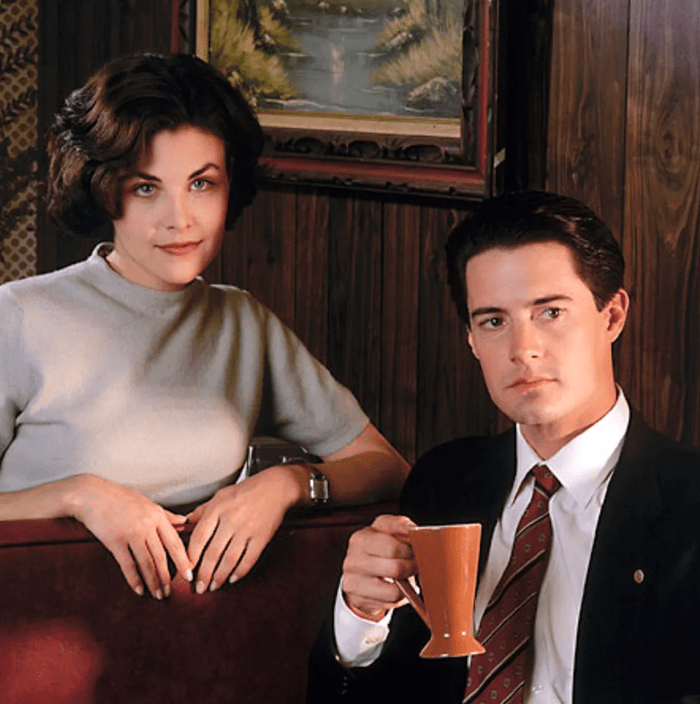
This is why the show’s villain is ultimately not a monster but a father. That choice, unambiguous in the original series, made even more explicit in Fire Walk With Me, is what elevates Twin Peaks from mystery thriller to genuine tragedy. The evil was domestic. It was familiar. It wore a face everyone recognized and trusted.
And Twin Peaks was not alone in arriving at this conclusion. In January 1992, director Curtis Hanson released The Hand That Rocks the Cradle, a thriller filmed entirely on location in Seattle and Tacoma, Washington — the same geography, the same grey skies, the same handsome old houses with their views of Puget Sound. The film’s premise is almost a companion piece to Twin Peaks: a family living in an enviable home in an enviable neighbourhood, their lives invaded and slowly dismantled by a malevolence that wears a caregiver’s face. When asked why he chose the Pacific Northwest, Hanson was precise: “I wanted an idyllic family, living in a very nice old house, on a great street, in a great neighborhood, where most people who watch the movie go, ‘Gee, I’d like that life.’ Seattle just filled the bill for all of those reasons.” The horror of the film, like the horror of Twin Peaks, is not that something evil has come from outside — it is that the domestic ideal itself has been used as a weapon. The more perfect the surface, the more completely it can conceal what is underneath.
Three major works about domestic evil disguised as normalcy — Twin Peaks, Fire Walk With Me, and The Hand That Rocks the Cradle — were all produced in Washington State within a three-year window, between 1990 and 1992. None of them was in dialogue with each other in any meaningful creative sense. The region was simply compulsively generating this theme, the way a wound generates heat.
The Women the History Forgot
But perhaps the most precise mirror to Laura Palmer in real life was not a fictional character at all. Laura is, among other things, a portrait of a young woman using self-destruction as a form of control, in a situation where every other form of agency has been stripped from her. Lynch understood this not as moral failure but as a survival strategy gone catastrophically wrong.
In Seattle, in the same years, this was not fiction. The underground scene of the early 1990s was full of young women navigating the same intersection of creative intensity and self-obliteration, and the toll was real and documented. Stefanie Sargent, 24, guitarist and co-founder of the all-female Seattle punk band 7 Year Bitch, was found dead in her Capitol Hill apartment in June 1992, with a syringe near her body. Unbeknownst to the rest of her band, she had been struggling with heroin addiction and had been sober for eight months before relapsing. She died the same month her band’s debut album was due to be released. Then, on the morning of July 7, 1993, Mia Zapata, lead singer of The Gits, one of the most charismatic and gifted voices in Seattle’s underground, was raped and murdered while walking home from the Comet Tavern in the same Capitol Hill. She was 27. Her wake was attended by a thousand people; candlelit vigils were held across the city. The crime went unsolved for nearly a decade. 7 Year Bitch’s second album was dedicated to both Sargent and Zapata; their deaths in consecutive years devastated the underground community and caused most of the bands in their orbit to break apart.
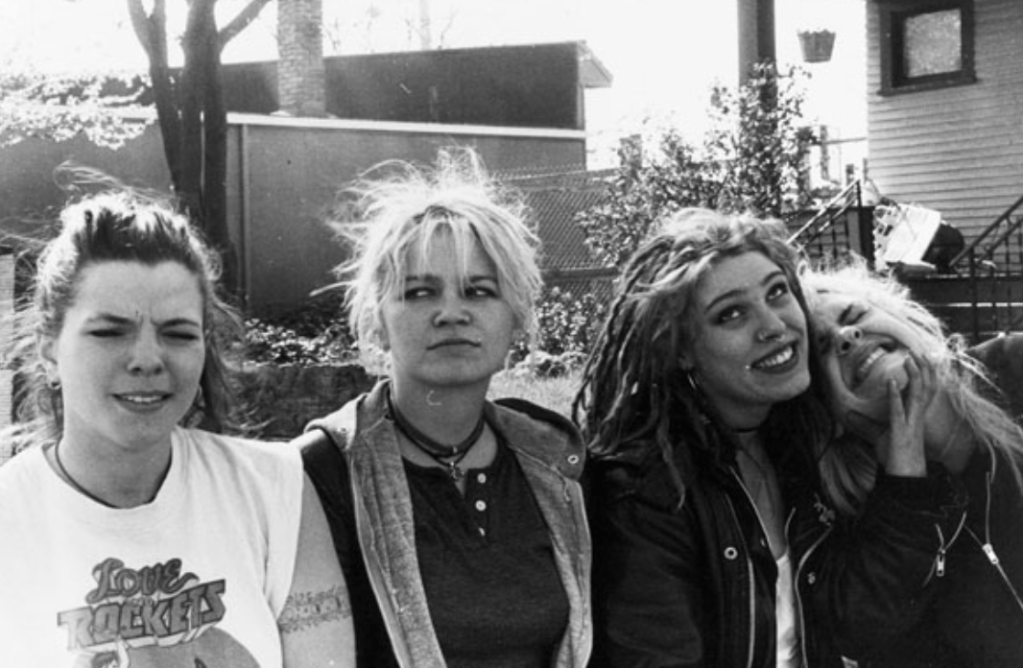
Two months after Kurt Cobain’s death, in June 1994, Kristen Pfaff — bassist for Hole, the band fronted by Cobain’s widow Courtney Love — was found dead in the bathtub of her own Capitol Hill apartment. She was 27. The cause was acute opiate intoxication. What makes her death particularly haunting is its specific cruelty of timing: Pfaff had already completed rehab, had quit Hole, and had packed a U-Haul trailer outside her building, ready to leave Seattle and move back to Minneapolis the following morning. She had understood, clearly, that the city was killing her. She was hours from escaping it. Her guitarist, Eric Erlandson, had warned her when she first arrived: “The only way you can survive in this town is if you don’t make those connections.” She had made them. So had almost everyone around her.
Demri Parrott, Layne Staley’s ex-fiancée, was part of the same world: a beloved presence in the Seattle underground scene, pulled under by the same drug that was claiming so many others. She died in 1996, at 27, from an OD.
The history of grunge has largely been written as the story of its male artists: Cobain, Staley, Vedder, Cornell. But the women of that scene were living equally extreme versions of the same contradictions: the beauty of the place, the creative intensity of the underground, the heroin that was everywhere, the violence that women specifically faced in ways that men did not. Laura Palmer, for all her fictional status, was not an invention. She was a recognizable silhouette. Young women in Seattle in 1990 understood something about her that the rest of the country was still trying to work out, not because Lynch had invented something, but because he had described something that already existed, with terrible accuracy, in the world just outside the camera frame.
What Was Happening in Seattle
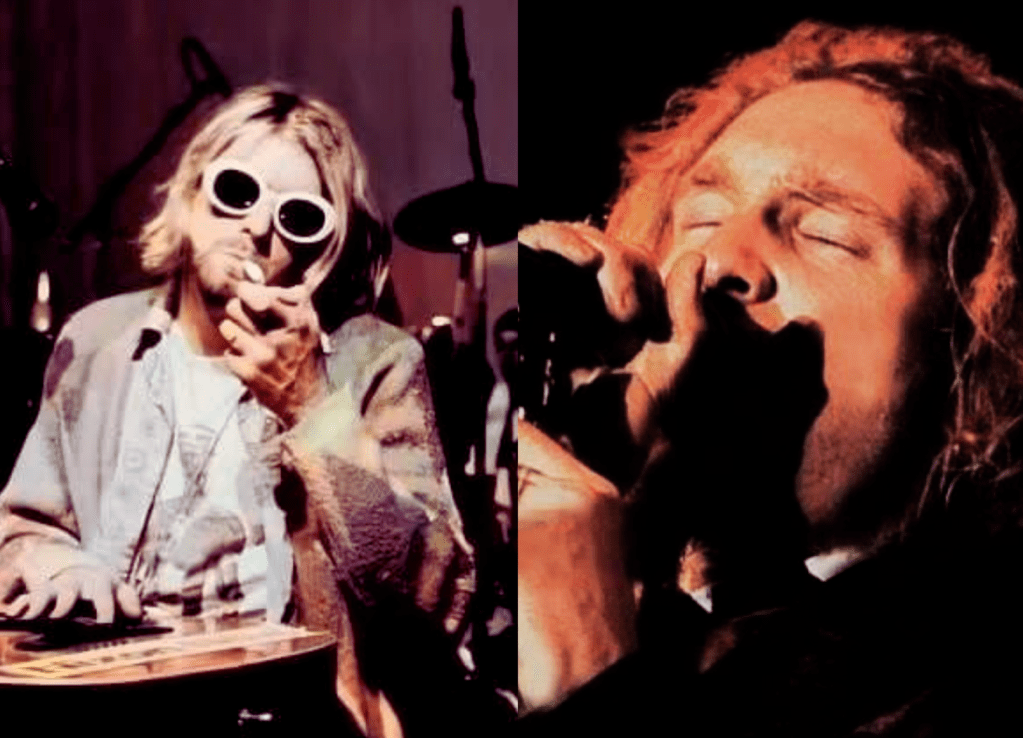
While Twin Peaks aired its first season in the spring and summer of 1990, a different kind of darkness was building in the clubs and rehearsal spaces of Seattle. Nirvana, Pearl Jam, Soundgarden, and Alice in Chains — these bands were not a coordinated movement with a shared manifesto. They were, in retrospect, symptoms of the same Pacific Northwest condition that Lynch had been filming. They had grown up in the same landscape, absorbed the same contradictions, and arrived at the same set of emotional truths by entirely different routes.
A timeline of convergence:
1986–1989: Sub Pop Records forms in Seattle and begins releasing early recordings by Soundgarden, Mudhoney, and a band from Aberdeen called Nirvana. The sound is already fully formed: heavy, melodic, and catastrophically sad. The Pacific Northwest aesthetic — beauty and desolation occupying the same space — is encoded in the music from the beginning.
April 8, 1990: Twin Peaks premieres on ABC. In the same season, Alice in Chains releases Facelift. Soundgarden releases Louder Than Love. The parallel eruption — one in television, one in music — goes largely unnoticed. Nobody draws the connection. The connection is structural. Exactly four years later, on April 8, 1994, Kurt Cobain’s body is discovered in his Seattle home. The date that launched the defining cultural artifact of the Pacific Northwest is the same date that closed its most iconic life. Nobody planned that either.
September 1991: Nirvana releases Nevermind. Within months it displaces Michael Jackson at number one on the Billboard chart. The Pacific Northwest goes mainstream — but it carries its darkness with it, unaltered. Twin Peaks has just been cancelled after its second season. The timing is almost comically precise.
1992: Alice in Chains releases Dirt, a record about heroin addiction so unflinching it is almost unlistenable — and one of the most important albums of the decade. Pearl Jam releases Vs. Lynch releases Fire Walk With Me, his most brutal examination of the Twin Peaks universe, to near-universal incomprehension.
April 5, 1994: Kurt Cobain dies in Seattle. He is 27. The official ruling is suicide. It has never been formally reopened. What has never fully dissolved, however, is the unease around the investigation, the questions about evidence, the heroin levels so extreme that several forensic specialists have argued they would have rendered him incapable of pulling a trigger, the note that reads, to many eyes, more like a letter of resignation from the music industry than a farewell to life. Whether one believes the official conclusion or not, the case shares something structural with Twin Peaks’ central horror: the possibility that the most obvious explanation, the one everyone agrees to accept, is protecting something that nobody wants to name. In the show, that figure is Bob: a force that inhabits the people closest to its victims, that operates in plain sight, that is never called to account because doing so would require the community to look directly at what it has chosen not to see. Bob is not a monster from outside. He is the darkness that domestic love enables and conceals. The parallel is not an accusation. It is an observation about the shape of certain kinds of grief, the kind that comes with a locked door, an unanswered question, and a community that closes ranks around the silence.
April 5, 2002: Layne Staley dies in Seattle, of a heroin and cocaine overdose. He is 34. His body is not found for two weeks. He and Cobain died on the same date, eight years apart, a coincidence that Seattle rock fans speak of with the quiet reverence usually reserved for mythology.
The Same Darkness, Two Languages
Kurt Cobain was born in Aberdeen, Washington, a logging town on the coast, economically devastated, spiritually exhausted, the kind of place the Pacific Northwest produces in abundance once the timber industry collapses and leaves nothing behind but scenery and unemployment. When Cobain sang in Something in the Way about living beneath a bridge, about animals as his only companions, he was deploying the Pacific Northwest landscape as a metaphor for interior desolation, exactly as Lynch had done in Twin Peaks, and for the same reasons.
Layne Staley was born at Overlake Hospital in Bellevue, Washington, in 1967, and grew up in the Seattle suburbs. The world Alice in Chains built on Dirt — about a body turning against itself, about the terrible intimacy of addiction, about the way destruction can feel, in its early stages, like the only honest response to being alive — maps with uncomfortable precision onto the show’s insistence that the most frightening evil is not supernatural in origin. It is domestic. It is familiar. It has a face you trust.
Neither Lynch nor the Seattle musicians were in direct conversation with each other. There is no documented mutual influence. What they shared was geography and, through geography, a sensibility shaped by the same contradictions: the coexistence of sublime natural beauty and human failure, the specific grief of communities that had lost their economic purpose, the Pacific Northwest suspicion that surfaces, however gorgeous, is always hiding something.
A structural parallel worth noting:
Both refused resolution. Twin Peaks ended its original run with Cooper trapped in the Black Lodge. Nirvana’s final album, In Utero, is deliberately uncommercial, a refusal of the resolution that mainstream success offered. Alice in Chains’ long silence after 1996 is its own form of unresolved ending.
Both made the body the site of horror. Laura Palmer’s body is the show’s first and organizing image. Dirt is about what heroin does to a body from the inside. Fire Walk With Me and “Down in a Hole” are, in different registers, the same meditation.
Both were suspicious of surfaces. Twin Peaks’ central revelation is that the most respected man in town is the monster. Grunge’s central aesthetic gesture is the refusal of polish, the distortion pedal as a form of anti-lie. Both understood that beauty maintained at the cost of truth is itself a form of violence.
Both were deeply, specifically regional. This is not universal darkness. It is Washington State darkness — shaped by a particular landscape, a particular economic history, a particular relationship between the wilderness and the towns carved into it.
The Shore: Kiana Lodge and What It Means
The Kiana Lodge, owned by the Suquamish Tribe, sits on the western shore of Puget Sound in Poulsbo, Washington. It is a beautiful place: log-built, decorated with Indigenous Pacific Northwest art, including a raven mural by the artist Duane Pasco that appears in the background of the Great Northern Hotel scenes. Bainbridge Island sits in the middle distance across the water. The light, in the right season, is extraordinary.
Lynch chose it for the pilot episode in 1989 because it possessed something indefinable. The beach scene was shot in March of that year. Pete Martell, a sawmill worker, leaves for a morning of fishing, hears a lonesome foghorn blow, and notices something at the base of a large log on the shore. It is a body. It is Laura Palmer. It is wrapped in plastic. The image and the log itself became one of the most reproduced frames in television history.
The log is still there, chained to the beach to prevent the tides from taking it. Fans come from across the world to stand beside it.
Layne Staley had chosen Kiana Lodge as his wedding venue. He and his then fiancée, Demri Parrott, whom he had met in Seattle, with whom he shared a heroin habit that was already pulling both of them under, had selected the lodge for their ceremony. The wedding never happened. Demri died on October 29, 1996, from an infection caused by a dirty needle. She was 27.
His memorial service was held at Kiana Lodge, the place he had chosen for the life he was supposed to have, on April 28, 2002. The same beach. The same log. The same light over Puget Sound. Attendees said that half of the photographs displayed at the service included Demri Parrott. It was, as one person present described it, like attending two memorial services at once.
In March 1989, a fictional dead girl was found on the beach at Kiana Lodge, wrapped in plastic, beside a log that had been chained there ever since. In April 2002, a real musician’s memorial service was held inside the same lodge: the place he had chosen for his wedding, his future, everything he lost before he had the chance to lose it. Nobody planned this. The Pacific Northwest arranged it.
The Real Darkness Nobody Could Name
The Green River Killer, Gary Ridgway, murdered at minimum 49 women across King County, Washington, throughout the 1980s and into the 1990s. His victims were found near rivers and roadsides, in the same general geography as the Twin Peaks filming locations, during the same years that both the show and the Seattle music scene were doing their cultural work. He was not caught, tried, or convicted until 2001 and 2003, respectively. For the entirety of the grunge era’s cultural prominence, an actual serial killer was operating, uncaptured, across the same landscape.
This context does not explain either Twin Peaks or grunge. Art is not reportage, and neither Lynch nor Cobain nor Staley was writing documentary accounts of Pacific Northwest crime statistics. But it matters that these artists were not working in abstraction. The violence in Twin Peaks is not imported atmosphere. The desolation in grunge is not borrowed alienation. They were made in a specific place that had already been teaching its residents, for decades, that the gap between the beautiful surface and what lies beneath it is not merely aesthetic. It is moral. It is criminal. It is the thing nobody mentions at the town meeting, the school board, or the family dinner.
What Lynch, Cobain and Staley understood, each in his own idiom, was that the most dangerous silences are the domestic ones. The ones maintained by people who love each other. The ones that protect the community’s image at the cost of someone’s life.
What Endures
Twin Peaks was cancelled in 1991, returned in 2017 with The Return, a third season so formally radical and emotionally devastating that it rewrote what television was capable of, and returned once more in 2025. Alice in Chains continued, survived, and made new music. Nirvana became a permanent archive. The landscape they all drew from did not change.
What both Twin Peaks and the grunge movement created was a grammar for a very specific American experience: the experience of a place that is beautiful and economically broken, where community fails the people it is supposed to protect, where the interior life is simultaneously the most private and the most dangerous territory. That grammar did not age because the conditions that produced it did not vanish.
The log is still chained to the beach at Kiana Lodge. The tides still come in. The light over Puget Sound is still extraordinary. And somewhere in the gap between the beauty of the place and what has happened there, the thing that Twin Peaks and grunge were both trying to say continues to wait — not for resolution, which it will not receive, but for acknowledgement.
The owls, as the show told us, are not what they seem.
They never were.
“Laura is the one.” — David Lynch


Leave a Reply